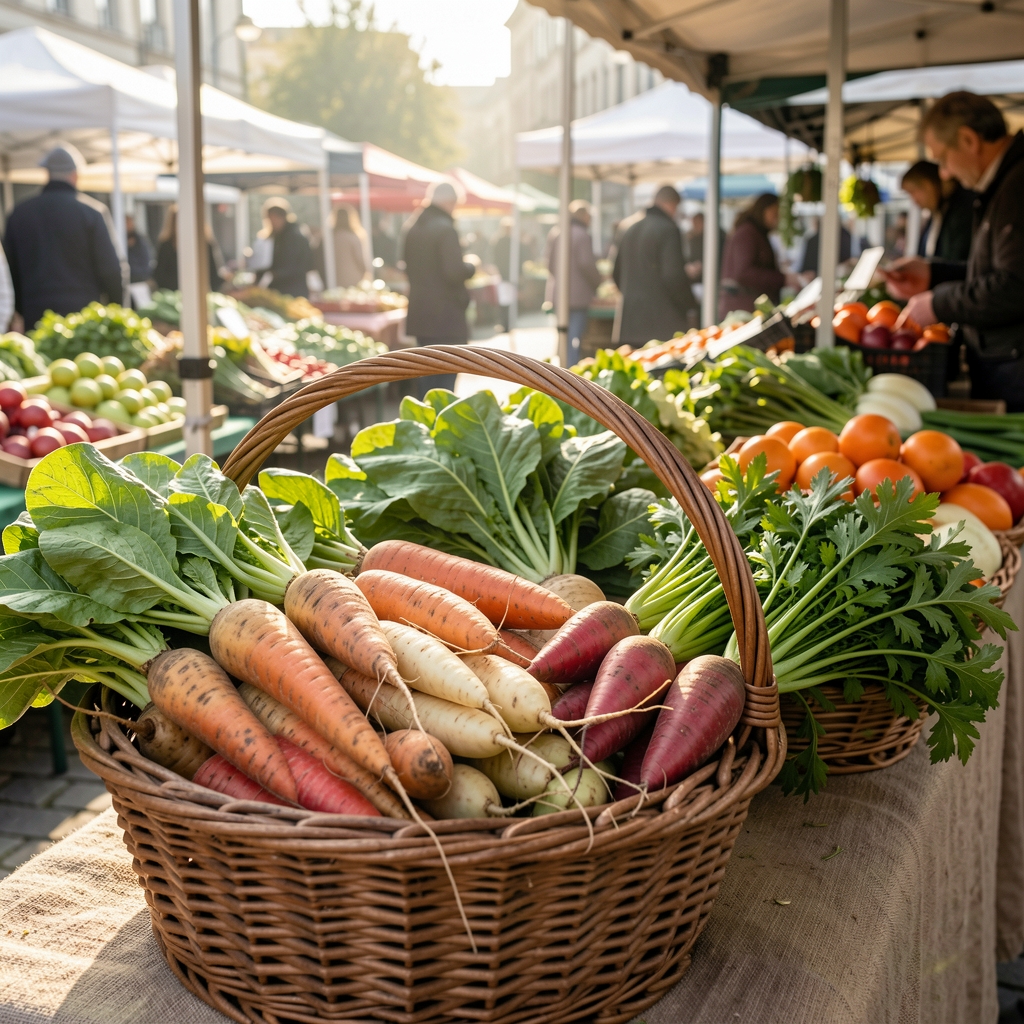
The weekly plate does not remain static. It shifts with the season, with what the markets carry, with what home cooking makes straightforward. In January and February, it tends toward root vegetables, brassicas, stored legumes, and the preserved or frozen produce of the previous autumn. By April, the plate begins to lighten. Observing this seasonal rhythm closely over twelve months produces a record that reveals something the nutritional literature confirms: seasonal produce patterns correlate with changes in dietary variety, which in turn associate with weight balance over time.
January to February: The Root Vegetable Foundation
The early months of the English year produce a plate that is, structurally, one of the most nutritionally dense of any season — though it rarely receives that acknowledgment. Root vegetables available in January and February include parsnips, celeriac, beetroot, turnips, swede, and carrots in several varieties. Brassicas — cabbage, kale, Brussels sprouts in their late-season form, and purple sprouting broccoli from mid-February — add a complementary range of fibre and micronutrients.
The energy density of winter root vegetables tends to be higher than summer salad crops, and meal volumes cooked from them tend to be larger — slow-roasted trays, long-simmered soups, substantial gratins. This does not present a difficulty for weight awareness when the foundation is whole food. The satiety produced by a substantial root vegetable and legume soup, with its combination of fibre, protein from the legumes, and the slow energy release of complex starch, is one that processed convenience food of equivalent energy content cannot replicate.
The field notes for this period record a consistent pattern: weeks built around home-cooked root vegetable dishes carried lower reported between-meal hunger than weeks with more reliance on convenience lunches. This observation does not establish causation, but it aligns with what dietary fibre and satiety research documents across larger cohorts.

The Transition Into Spring: Nutritional Variety and the Shifting Plate
By late March and into April, the available produce range expands perceptibly. The appearance of the first English asparagus, the arrival of spring onions, radishes, and tender salad leaves, and the continued presence of sprouting brassicas marks a transition that changes the character of the weekly plate more profoundly than any deliberate dietary adjustment. The plate lightens not because of a nutritional decision but because the available ingredients change.
Published nutritional research on dietary variety and weight balance consistently identifies variety as a moderating factor in nutritional outcomes over time. A diverse range of vegetables and fruit supports a broader profile of micronutrients, and the fibre variety across different plant foods has distinct effects on the gut environment. The seasonal transition into spring naturally increases the plate's variety — the monotony of the winter root vegetable repertoire gives way to a wider range of textures, colours, and preparation approaches.
The field notes for this transition period show an increase in meal preparation frequency and a corresponding decrease in reliance on convenience foods. The spring produce range, with its emphasis on quick-to-cook and raw preparations — a bunch of radishes with butter, a simple asparagus with eggs, a bowl of spring greens dressed with olive oil — lowers the practical barrier to home cooking in a way that slow winter cooking does not. The result is a structural shift in the week's food rhythm that registers in the weekly record as improved dietary variety without any formal dietary intention.
"The plate lightens not because of a nutritional decision but because the available ingredients change. Seasonal produce cycles do work that no dietary plan can replicate."
Seasonal Produce and Gradual Weight Change
The relationship between seasonal produce and weight is documented in population-level dietary research primarily through the association between fruit and vegetable intake and weight over time. The mechanism is composite: higher fruit and vegetable intake tends to correlate with higher fibre intake, lower energy density per volume of food, greater meal satisfaction, and — in populations that cook primarily from whole ingredients — lower overall reliance on processed foods.
What seasonal produce adds to this picture is practical accessibility. The argument is not that seasonal vegetables are nutritionally superior to their out-of-season counterparts in every respect. It is that seasonal produce tends to be more readily available, often better in quality, and — in a market or greengrocery context — less expensive than imported equivalents. These practical features lower the barrier to the kind of routine vegetable-led cooking that sustains long-term dietary variety.
Gradual weight change, in the nutritional literature, correlates with sustained dietary pattern shifts rather than with intense short-duration dietary changes. The seasonal plate rhythm provides exactly the kind of sustained, low-effort pattern that this literature identifies as most relevant to long-term weight balance. No week requires exceptional effort or unusual ingredients; the season itself provides the variety.
Plant-Based Meals and the Seasonal Calendar
Plant-based meal preparation sits naturally within seasonal eating. The English growing calendar provides enough variety across twelve months to build a genuinely diverse plant-centred repertoire without recourse to imported or processed substitutes: legumes and pulses year-round, brassicas and roots through autumn and winter, alliums across all seasons, and an expanding range of salad crops, courgettes, tomatoes, and summer beans from late spring onwards.
A plant-centred approach aligned with the seasonal calendar produces, in practice, a weekly plate that naturally varies in texture, colour, flavour, and nutritional profile across the year. The January plate of lentil and celeriac soup bears little resemblance to the July plate of broad bean and herb salad — yet both are coherent, nutritionally substantial, and straightforward to prepare from available produce.
The field notes across the full twelve-month observation period showed consistently higher reported meal satisfaction in weeks characterised by home-prepared plant-based meals from seasonal produce. The satisfaction was noted both in terms of fullness duration and in subjective meal quality — the latter likely connected to the flavour advantage that seasonal produce carries over stored or out-of-season equivalents.
Cooking, Home Preparation, and Weight Awareness
The research literature on home cooking and weight consistently shows a positive association between home-prepared meals and better nutritional outcomes — including, where measured, more stable weight over time. The association operates through several channels: home cooking allows direct ingredient control, which supports portion awareness; it tends to incorporate more whole ingredients and fewer added sugars, fats, and salts than restaurant or convenience food equivalents; and the preparation process itself engages attention with the meal in a way that delivery or packaged convenience food does not.
Seasonal produce facilitates home cooking in a practical sense. The straightforwardness of roasting a tray of winter vegetables, the speed of preparing spring asparagus with a soft-boiled egg, the minimal effort of a summer salad with good tomatoes — these are low-barrier preparations that require more attention than heating a packaged meal, but considerably less than elaborate recipe execution. They are the kind of cooking that a regular week can absorb.
The weekly food rhythm that the field notes document is, at its foundation, a cooking rhythm. The weeks that carry higher nutritional quality and stronger weight-related awareness are, almost without exception, weeks in which more meals were prepared at home from whole ingredients. The produce provides the material; the cooking habit provides the structure. Together, they form the weekly plate rhythm that this observation set out to record.
- 01 The seasonal produce calendar provides natural dietary variety without requiring formal dietary planning.
- 02 Winter root vegetables and legumes support sustained energy and satiety when prepared as whole-ingredient home cooking.
- 03 The spring produce transition naturally increases meal preparation frequency and reduces convenience food reliance.
- 04 Gradual weight balance correlates with sustained dietary pattern — seasonal cooking provides exactly this kind of sustained, low-effort pattern.
- 05 Home preparation from seasonal ingredients was the strongest single predictor of nutritional quality in the weekly record.
Articles published on Karove Notebook are editorial in nature and reflect the writers' observations on everyday nutrition practices and weight awareness. The content is not intended as professional advice, nor as guidance for the management of any specific condition. Readers with specific concerns about their daily routines are encouraged to speak with a qualified wellness professional.